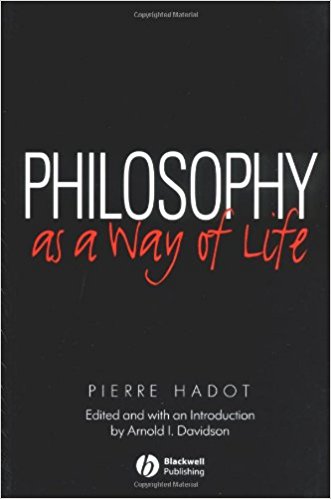
Pierre Hadot (1922–2010) was a French philosopher and historian of ancient philosophy, especially of Plato, Aristotle, Stoicism, Cynicism, Epicureanism, and Neoplatonism. He was a professor at the Collège de France in Paris where he also wrote and taught on a number of philosophers, including Marcus Aurelius, Plotinus, Descartes, Kant, Kierkegaard, Wittgenstein, and Merleau-Ponty, to name a few. In this essay, I draw from several of his translated works, including What is Ancient Philosophy? the collection of essays found in Philosophy as a Way of Life, his work Plotinus or the Simplicity of Vision, and his text on Marcus Aurelius, The Inner Citadel. The essay serves as an overview and introduction to the thought of Pierre Hadot. However, what follows is not a reconstruction of any particular school of philosophy. Nor does the essay offer a linear reconstruction of the history of these philosophies.
Instead, in this essay I recreate the sense of what Hadot found so crucial to philosophy. Namely, the idea that philosophy is a way of life, a set of practices spiritual in nature. Philosophy for Hadot is a means of integrating questions of ethics, knowledge, being, and aesthetics into the actions and choices of the person. All of these concerns, Hadot often underscores, are developed for the sake of creating an ability to care for ourselves and one another, for developing a more comprehensive understanding of human beings and the world, and for maintaining a political obligation to a community. The assumption I make is that Hadot not only writes about the history of ancient philosophy, but also gives his readers his own approach to philosophical practice through the historical account he offers. Continue reading
 In my last few posts
 Hubert Dreyfus is most well-known for offering an account of intelligent human coping without appealing to explicitly cognitive or rational sources of action. Following philosophers such as Maurice Merleau-Ponty and Martin Heidegger, Dreyfus instead roots human intelligence—theoretical or otherwise—in our embodied everyday comportment with the world, in our practical actions and responses to the immediate environment. In Mark Wrathall’s words, “Rather than starting from cognition as the primary locus of intelligence, and building out to an account of action, Dreyfus starts with the premise that skillful activity itself is the consummate form and foundation of human intelligence, and derives an account of cognition from coping.”
 Knowledge Ecology