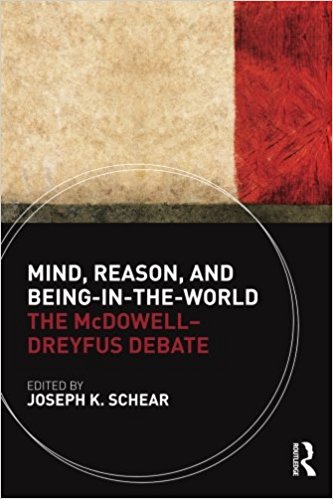
 In my last post on Hubert Dreyfus and the intentional arc, I ended with a question about the relationship between intuitive responses to environmental solicitations in expert action. In this post, I continue to explore the structure of intuitive response through the work of John McDowell.
It is precisely on the status of intuition in perception where I find Dreyfus’s account wanting, and where I think McDowell gets it right. It seems that Dreyfus takes everything traditionally attributed to concepts and conceptual ability and repositions these skills as available to an agent at the ground floor of perceptual experience through nonconceptual motor understanding. But what sense does it make, for instance, to speak, as Dreyfus does,[1] not only of perceptual knowledge but also of nonconceptual beliefs about perceptual objects and the solicitations, affordances, and constraints that issue from my engagement with them? The appeal to solicitations (or to what an object obliges of me), to affordances (or to what an object may aid me in doing), and to constraints (or to what an object may prevent me from doing), seems squarely in the domain of a cognitive and inferential space, in other words, a space shot through with a conceptual understanding that interleaves my every practical action. Indeed, this is precisely the stance that McDowell takes against Dreyfus.
 Hubert Dreyfus is most well-known for offering an account of intelligent human coping without appealing to explicitly cognitive or rational sources of action. Following philosophers such as Maurice Merleau-Ponty and Martin Heidegger, Dreyfus instead roots human intelligence—theoretical or otherwise—in our embodied everyday comportment with the world, in our practical actions and responses to the immediate environment. In Mark Wrathall’s words, “Rather than starting from cognition as the primary locus of intelligence, and building out to an account of action, Dreyfus starts with the premise that skillful activity itself is the consummate form and foundation of human intelligence, and derives an account of cognition from coping.”
 Knowledge Ecology