
This will be a bit of a throw-away post as I really should be working on other things right now, but I had to jot down some notes while these ideas are still fresh. I’ve been thinking of ways to integrate the different accounts of perception I’ve been studying as of late, and the phrase “perception in 4 dimensions” dropped into my head.
I think a good term for a perspective is as important as the content of the perspective itself, and perceiving in 4D has been wringing in my head since last night. On the face of it, there’s nothing exciting about perceiving in 4D. It’s what you’d expect from a creature such as ourselves, orienteering around the world along three spatial axes and an additional temporal one.
But I’ve been thinking about the phrase in a different way.
I think proper 4D orienteering must include something like Bergson’s intuition about duration. The idea in this context would be that living beings don’t just move through time and space but in some sense accumulate or become organized through their successive actions and endeavors. Time is a cumulative repetition captured in the ongoing transformations of the organism through its lifespan and across the contexts it finds itself in. It’s not an abstract ideal or an empty space.
I haven’t thought this through too deeply, but duration in this sense is an integrative fact that unites cognition, perception, and embodiment. Duration also connects the organism’s engagement with its environment, both in the sense of the ongoing work required to get a world to show up (through the energetic resources required to keep it going), and in the sense that the lifeform outsources its cognitive and perceptual needs to artifacts (built and natural) in that ecology.
Consider also the case of perceptual learning, a view that suggests an intimate link between practices, behaviors, and the organization of the sensory modalities of the perceptual system. If something like genuine perceptual learning is true—i.e., that learning constitutes changes that are actually perceptual, rather than changes merely indicative of shifting after-the-fact inferences about the sensory system’s deliverences—then a concept like duration can again provide a helpful integrating function.
So, the quick and dirty rub is that perception in 4 dimensions isn’t simply the observation that lifeforms operate along four axes of possible action (a Newtonian view of organisms if ever there was one), but that any real account of perception acknowledges that duration is an integrative function wherein enaction, extended cognition, feeling, and perceptual learning all come together in and as the transformation of the lifeform.
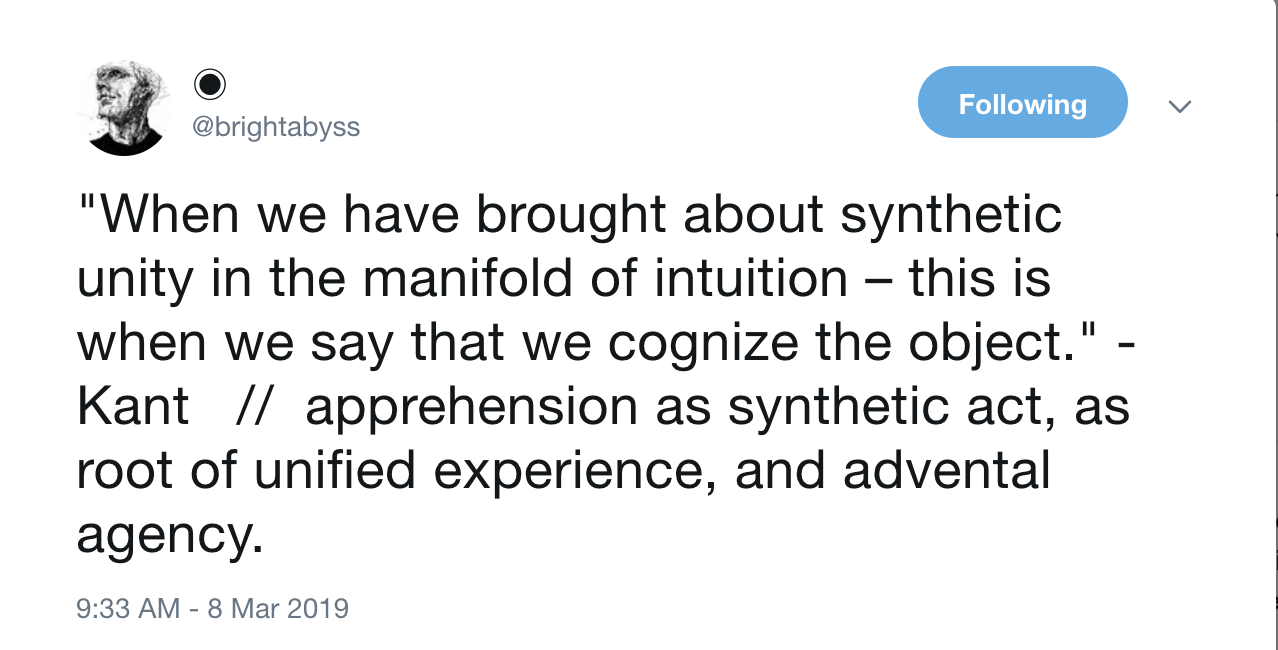 I think often about these passages in Kant
 I’ve been writing recently about epoché as an exercise (or askēsis) of perception. I take epoché in this context to mean something like bracketing or suspending one’s immersion in perception so that one can evaluate the construction of experience from a different angle.
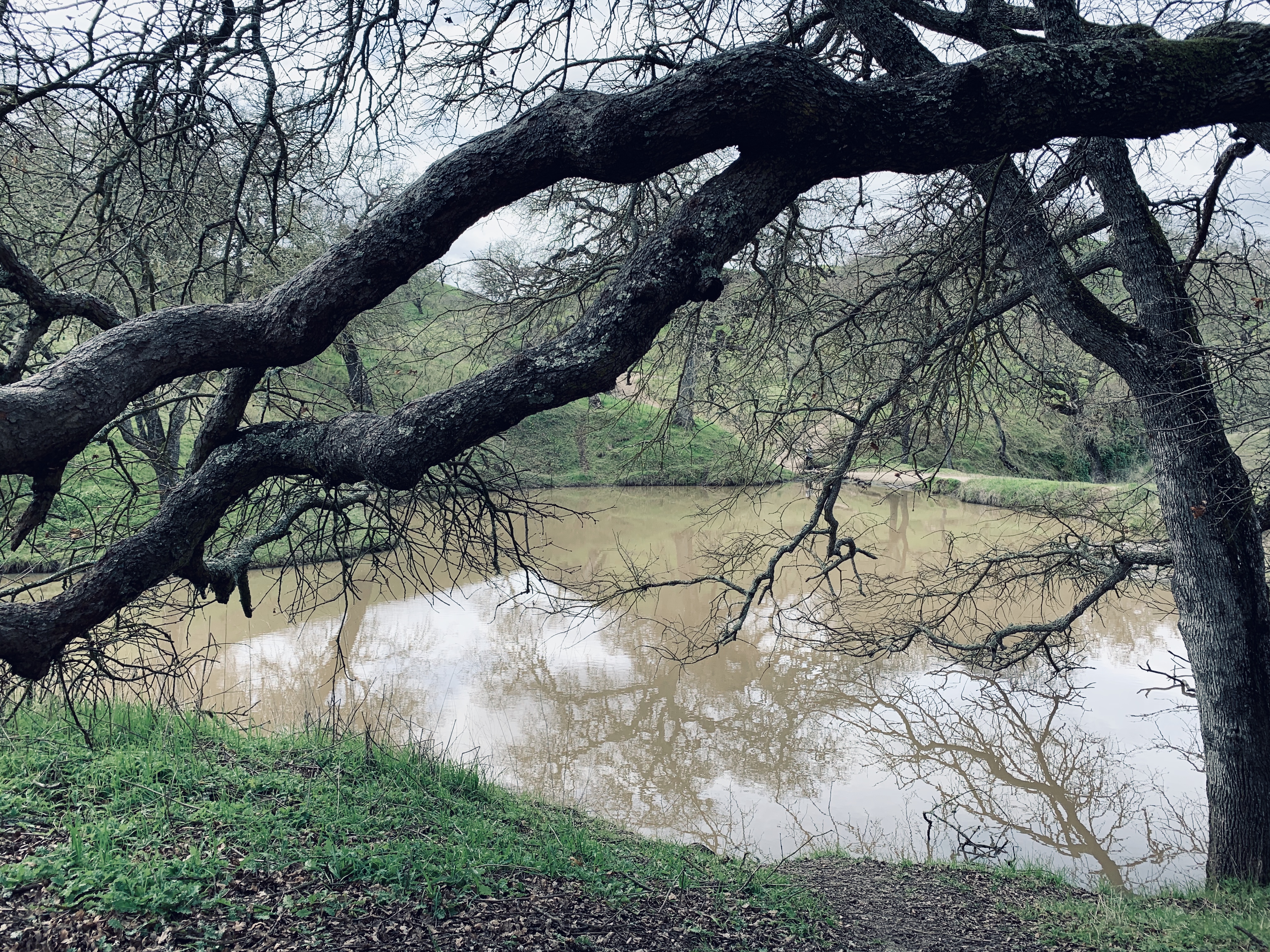 I write sometimes about philosophy as a way of life, as an exercise (askēsis) of conversion or transformation. But one could also write a parallel story of art as a way of life, as an aesthetic askēsis likewise oriented around a re-constellation of sensing, feeling, and thinking.
 The phrase “contemplative philosophy” denotes a specific understanding of theory and practice that transforms the meaning of both terms. One could say that this transformation implies a recursive relationship between theory and practice, but this move doesn’t go far enough.
 Knowledge Ecology